

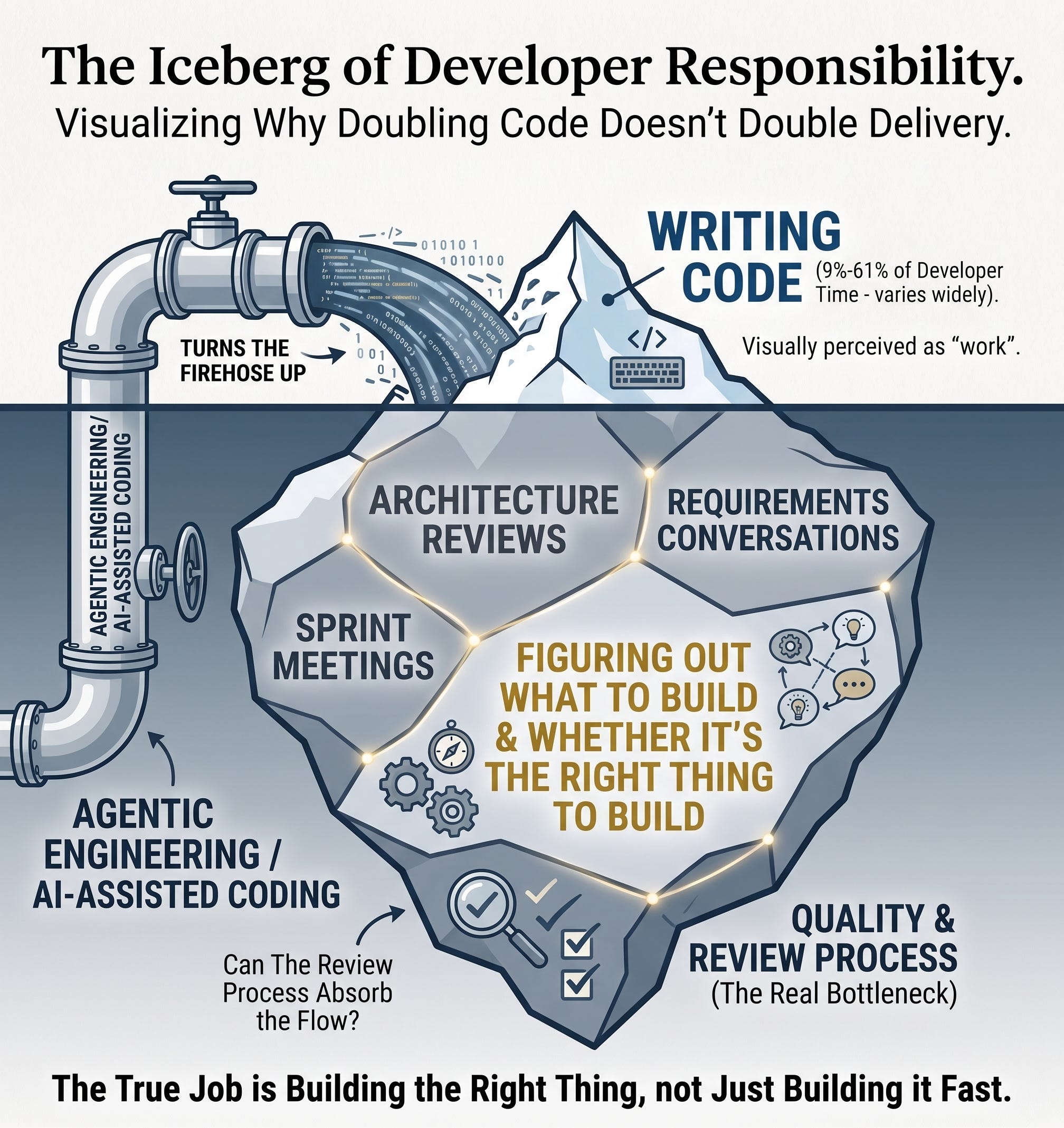
A 2019 study co-authored by Microsoft Research gathered nearly 6,000 self-reports from professional developers about what they actually do all day. The answers did not surprise anyone who has sat through countless sprint meetings, architecture reviews, and requirements conversations.
Writing code turns out to be one of the smaller things developers do. Estimates vary widely by study, anywhere from nine percent of the day to sixty-one percent. Either way, a large share of every day goes to something other than typing: figuring out what to build, and whether it’s the right thing to build at all.
Most of the day isn’t code
Which is why you can double your rate of code production and watch the gain evaporate. Typing was never what slowed delivery. You produce more code, which puts pressure on things like the review process. Turn the firehose up and the question becomes whether your review can absorb the flow at quality. Most teams never measure that before they turn up the volume.
Agentic engineering is that valve thrown wide open. It pours code into the pipeline you already have, faster, and magnifies the debt you were already carrying. You feel quick in the one place you can see, lines appearing on screen, while the parts that actually gate delivery get slower.
The job behind the keyboard
Your role was always translation, turning requirements from the business into something that adds value to your users. The keyboard work was the visible proxy for that, the thing you could point to at the end of the day. Now the proxy is cheap and the real work stands exposed.
Does this match the requirement? Which constraints apply? Writing for an embedded device with kilobytes of memory and writing for a cloud platform at scale are different problems, and an agent will solve the wrong one with great fluency. Knowing which problem you’re in is the judgment that doesn’t go away.
What was actually scarce
None of this reads as loss once you see what was actually scarce. The craft pride of the profession attached itself to the code, because the code was the hard part you could hold up and show someone.
That pride is looking for its real object now. It was never the syntax or the speed of your hands. It was the judgment about what to build, and the taste to reject a fluent wrong answer by asking for options before you commit to one.
Keep those and the agent becomes the best junior engineer you’ve ever managed. Lose track of them and it’s a faster way to ship the wrong thing, with screenshots to prove how fast you got there.