

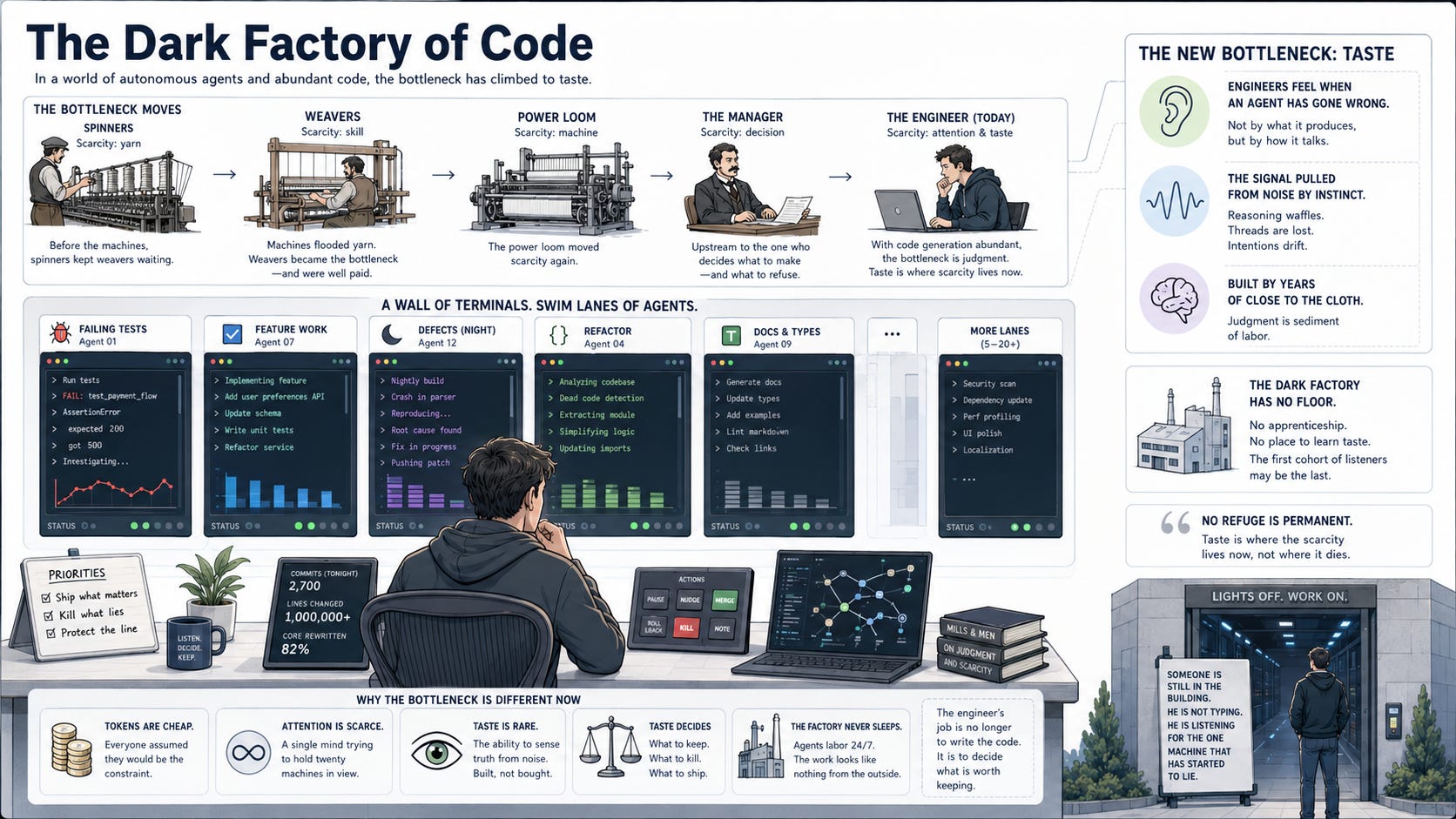
There is a kind of factory that runs without light. The Japanese built the first ones decades ago: robotic arms assembling other robotic arms in windowless halls, in the dark, because a machine has no eyes to spare and no need of the sun. Lights-out manufacturing, the trade called it. The phrase carried a faint dread, the suggestion of a place where the work continued after everyone went home, where the human had become not the worker but the absence the work was designed around.
Agentic engineers have carried the phrase into software. A software dark factory is a codebase tended by swarms of agents instead of hands, writing and rewriting itself around the clock, shipping faster than any person can read the diff.
The bottleneck is always paid
The idea is older than the silicon. It begins in the cotton country of the English north, where the first scarcity to die was not the weaver’s but the spinner’s. For centuries it took several spinners to keep a single weaver in yarn, and then the jenny and the water frame arrived and the yarn became a flood. The strange consequence, the one nobody predicted, is that the machines made the weaver rich. For a span of about twenty years a man who could throw a shuttle was among the best-paid laborers in England, because the bottleneck had moved to him, and the bottleneck is always paid.
Then the power loom came for the weaver too, and the scarcity moved again, upstream, into the man who decided what the mill should make and what it should refuse to make. The weaver, who had been the whole story, became a footnote to a machine.
A wall of terminals
An AI-pilled engineer will spin up what the trade calls swim lanes, five or ten or twenty of them at once, each a separate agent gnawing at a separate corner of the code: one on the failing tests, one on a feature, one chasing the defects that surface at night. The work, from the outside, looks like nothing. A man at a desk before a wall of terminals, each scrolling its own monologue, and him moving down the row the way a chess master walks a simul, ten seconds at a board, a glance, a nod, typing almost nothing, now and then killing a process mid-sentence with the briskness of a man who has heard enough.
He does not write the code. He cannot read all of it. One such engineer described a night that began as exhaustion and a bad idea at two in the morning and ended, by his own count, in twenty-seven hundred commits, a million lines changed, eighty-two percent of the core rewritten.
The tokens, which everyone assumed would be the constraint, are cheap. The constraint is the one resource the mill cannot manufacture, which is his attention, the finite span of a single mind trying to hold twenty machines in view at once. The bottleneck has climbed all the way up to taste.
The factory has no floor
Taste is a strange word to find at the end of an engineering story, but it is the right one. Engineers who live this way say they can feel when an agent has gone wrong. Not by what it produces but by how it talks, the way a manager senses that a clever subordinate has begun to bluff. The reasoning waffles. It loses the thread of its own intention. What they are catching is signal pulled from noise by an instinct nobody taught them, and here the story turns uneasy, because the instinct was not earned in the dark factory. It was earned in the years before, in the decades of writing code by hand, of being close to the cloth.
The mills knew this problem, though they never had to solve it. The owner’s eye for cloth was not a gift; it was a residue. He could tell good cambric from bad at a glance because he had spent his youth on the floor among the looms, had handled the stuff, had ruined some. His judgment was the sediment of labor, and when the labor moved into the machines there was still a floor downstairs, still a place a young man could go to ruin cloth and learn.
The dark factory has no floor. The judgment that supervises the machines was built by the very labor the machines have eliminated, and nobody can say where the next generation’s taste is supposed to come from, when no one types and there is nothing left to apprentice to. The first cohort of listeners may also be the last that knows what it is listening for.
No refuge is permanent
The dark factory, then, is not a story about speed. It is a story about where the human goes when the hands are no longer needed. We thought the engineer was the one who wrote the code. It turns out the engineer was always the one who decided what was worth keeping, and only now, with the writing given away, can we see that this was the work all along.
But the weaver believed his scarcity was sacred too, in the brief golden years when the machines were making him rich, and the rule the mills teach is that no refuge is permanent. Taste is where the scarcity lives now, not where it dies.
The lights are off. Someone is still in the building. He is not typing. He is listening for the one machine that has started to lie.