

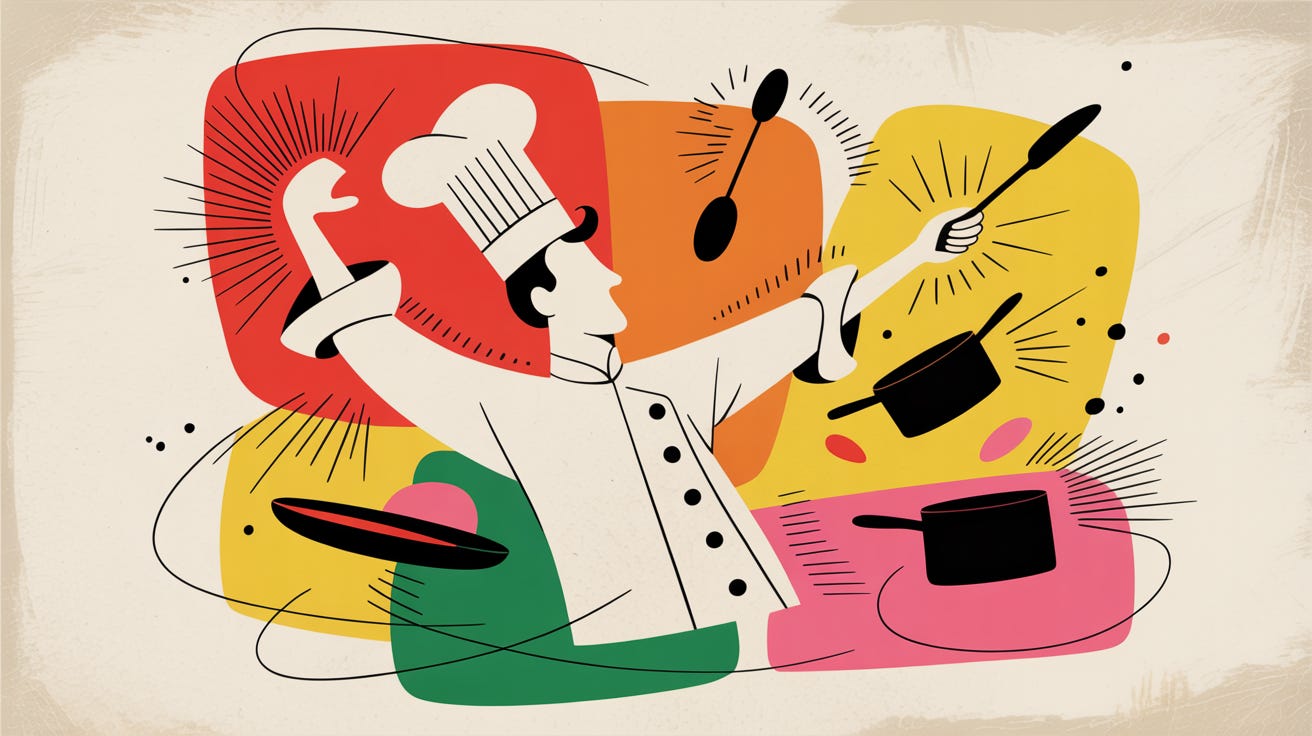
The kitchen of the Savoy Hotel, in the winter of 1890, ran on organized panic.
Professional kitchens then worked by a method called service à la française. It looked magnificent from the dining room and it was an operational nightmare behind the door. When a party ordered a feast, the kitchen prepared as many as thirty dishes to reach the table in the same moment. One cook chased a single dish the whole way: roast the bird, build the sauce, cut the garnish, plate it, then start again. The line was full of shouting and collisions and scorched copper. Food went out cold. When the dining room filled, the whole operation seized. To the guests in the velvet booths this was the price of luxury. The front of the house was calm and the back was a brawl, and the two were understood to be separate worlds.
Georges Auguste Escoffier decided everyone had the problem backward. They were all looking at the dishes. He looked at the flow of work instead.
His answer was the brigade de cuisine. He cut the kitchen into stations, one for sauces, one for roasting, and one for pastry, each cook responsible for a narrow part of every plate. The part that mattered most was a new job: the aboyeur, the announcer. The aboyeur stood at the pass, the counter between the dining room and kitchen. Waiters did not shout orders across the line. They handed them to the aboyeur, who turned the noise of the room into a fixed set of calls the stations could execute.
Now the front of the house could do anything. A guest could eat in the grand room, order to a private suite, or ask for supper in the parlor at midnight. The request always arrived at the same place. Escoffier had not only built a faster kitchen. He had built a single point of entry that let wildly different rooms drive one engine of production. He standardized the core.
The industry is celebrating the wrong thing
Enterprise software is standing in that kitchen right now and calling it the headless revolution.
Listen to any stage at a developer conference and the future belongs to the headless application. The premise is simple: remove the presentation layer, the graphical interface people click through, and keep a pure API.
Sold that way, it reads as liberation. Strip off the rigid web pages and desktop screens and developers are free to build a mobile app, a smartwatch widget, and a feed into an autonomous assistant. The head is gone and the surfaces are limitless.
That framing praises the wrong half of the change. It counts what got removed and ignores what now has to hold. An API gets treated as a magic doorway that dissolves the integration problem, when cutting off the head does nothing to make the body work. If every new experience needs its own bespoke API to reach your data, you have not built a flexible system. You have built a web of one-off connections that fails under its own weight.
The surface underneath
Call the thing that actually matters the unified surface: a deep, capability-rich layer under everything, exposing every service through one identical face. It does not care what is calling. A legacy web portal, a phone app, a voice assistant, and an autonomous agent running inside an MCP session, each one hits the same structural boundary.
Watch a single transaction to see why that boundary earns its keep. A customer is buying a limited item in a flash sale, not from a browser but from a chat window, through an agent that authenticates over an MCP session and queries inventory. The customer says buy. In the same second, a continent away, another customer clicks buy on the same item from an ordinary website. If those two requests travel different code paths, if the headless system has splintered into separate service layers, the database sees two truths. Inventory disagrees with itself and one sale collapses. That failure is not exotic; it is the ordinary result of letting each channel own its own copy of the rules.
Zoom out from the one transaction. A modern enterprise system is not a block of code on one machine. It is a sprawl of services across hybrid clouds and distributed databases, dozens of platforms that have to move data in near real time. At that scale the physics change. You inherit the hard part: keeping state consistent across nodes when the network is slow and always partly failing.
A single surface is what makes that survivable. Route every request through one layer and the system can enforce the guarantees that keep it honest, atomicity and isolation among them. A state change in one place is visible everywhere because there is only one place. Let the headless app be a pile of endpoints built by different teams on different sprints and you lose that. Send every request, from the mobile app or the chatbot or the enterprise service bus, into the same surface, and the system keeps control of its own state. It holds performance as volume climbs. It bends under load instead of breaking.
The core, not the screen
Escoffier’s brigade did not succeed by hiding the kitchen. It succeeded by forcing the whole hotel through one orchestrated interface, the pass, where every order became the same kind of instruction. That standard is what kept the food consistent from the station to the plate, however the guest chose to order.
So the thing worth celebrating about headless software is not the discarded screen. The missing interface is trivia. What matters is the surface underneath: one layer that brings order to a distributed system that would otherwise drift out of agreement with itself. Look past the absent head and mind the integrity of the body, and you can build systems that stay consistent while everything about how they get reached keeps changing. The power was never in how the software looked. It is in what happens below the surface and whether that one place can be trusted.