

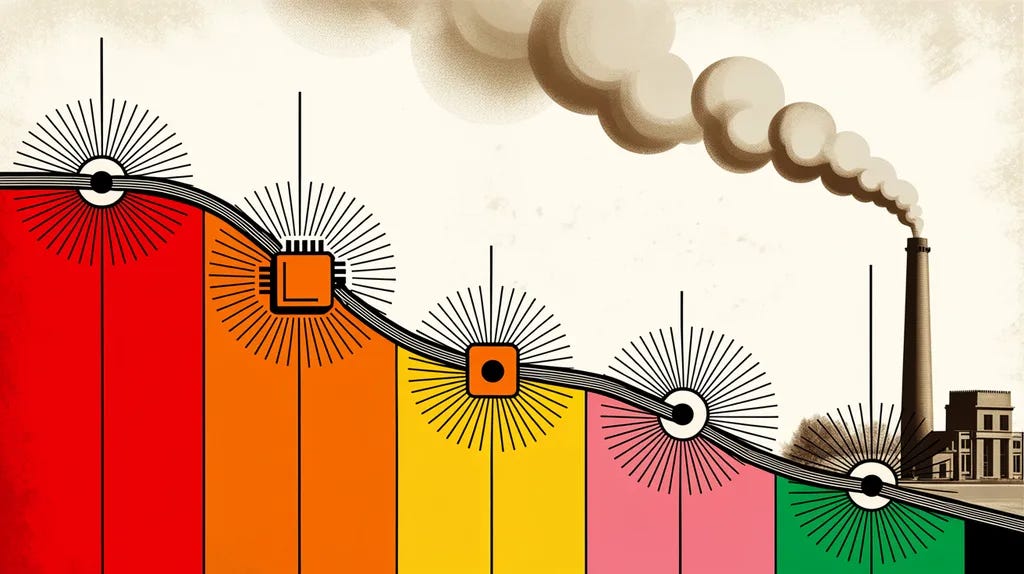
Every AI budget I’ve seen rests on one assumption nobody writes down: that tokens will keep getting cheaper faster than the company can find new ways to burn them. It’s an easy bet to make, because the first part is visibly true. The price of a normalized token has been falling for two years, pushed down by better models, cheaper inference, quantization, and competition among providers who all want your default. Anyone watching the per-unit numbers sees a line sloping toward zero and reasonably concludes the cost problem will solve itself if they just wait. Both halves of that bet are shakier than they look, and they fail for different reasons.
Jevons and the Coal Paradox
William Stanley Jevons worked out the first failure in 1865, looking at coal. The efficiency of steam engines had improved dramatically, and the sensible expectation was that Britain would therefore burn less coal per unit of work and stretch its reserves. The opposite happened. Cheaper, more efficient steam power made coal worth using for a hundred things it hadn’t been worth before, and total consumption climbed. Efficiency didn’t conserve the resource. It expanded the appetite for it.
Token spend follows the same curve, and the enterprise version is almost comically direct. A provider cuts the price of its model in half, and a finance team reasonably expects the AI line item to ease. Instead it grows, because the moment a token gets cheaper, three teams who couldn’t justify a feature at the old price can justify it at the new one. The support agent that was too expensive to run on every ticket now runs on every ticket. The summarization that was reserved for premium accounts now ships to everyone. The nightly job that scanned a sample of the codebase now scans all of it, twice. Each of those is a rational decision, made by someone looking at a unit price that finally cleared their bar. Added up across the company, they mean consumption grows faster than the price falls, month over month, and the bill goes up while every vendor email says prices went down. Both statements are true, and reconciling them is the whole job.
A team that understands this can at least plan for it. You stop treating each price cut as savings and start treating it as a demand trigger, because that’s what it is. You assume that cheaper tokens mean more tokens, not the same tokens for less, and you budget for the growth instead of being surprised by it every quarter. This is uncomfortable but manageable. It’s the second half of the bet that’s genuinely dangerous, because it’s the half people don’t examine at all.
The Physical Reality Underneath the Price Curve
The unexamined assumption is that the price line keeps sloping down, smoothly, more or less forever. It feels like a law, the way Moore’s Law felt like a law, and people extrapolate it the same way: draw the curve out three years, assume next year’s ambitious feature will be affordable by the time it ships, architect accordingly. But a token price is not a pure software abstraction that trends to zero because software wants to. It’s the retail price of a physical process, and underneath every fraction of a cent sit three things that don’t obey software’s economics: electricity, memory, and buildings.
Electricity is the one that’s already biting. The models run in data centers, the data centers draw enormous and growing amounts of power, and the grid is not expanding on the same timeline. Interconnection queues stretch for years in the regions where the capacity would go. Some jurisdictions have started slowing or blocking new data-center hookups because the load threatens residential supply. Power is the input that scales worst, and it’s the one the whole edifice needs most.
Memory is the second. Modern accelerators depend on high-bandwidth memory, a specialized component made by a short list of suppliers, and that kind of concentrated supply chain doesn’t respond gently to a demand spike. When everyone wants the same scarce part at once, the price of that part doesn’t glide downward on a nice curve; it jumps, and the jump lands in the cost of every token served on hardware that needs it.
Buildings are the third and slowest. A data center is a multi-year construction project with permits, land, cooling, and a power agreement that may not exist yet. You cannot conjure capacity in a quarter to meet a surge in demand, so when demand runs ahead of the concrete, the shortage shows up as price, and it stays there until the next wave of buildings comes online years later.
None of this means tokens get expensive and stay expensive. It means the smooth decline people are mentally banking is not something physics has agreed to. The realistic shape of token pricing over the next few years is lumpy: stretches of decline as new capacity and better models arrive, punctuated by flat periods and outright spikes when power, memory, or capacity binds. Structural volatility, not a glide path. And a budget built on a glide path breaks the first time the curve does something the spreadsheet didn’t allow for.
Treating Tokens Like a Commodity, Not a Line Item
So the move is to plan for a commodity, not a software line item. Treat tokens the way a manufacturer treats a volatile raw input: something with a price you don’t control, that can move against you, that you hedge and monitor rather than assume away. Concretely, that means a few things. Don’t ship features whose unit economics only work at a price you’re projecting rather than paying today; if it’s underwater at the current price, it’s a bet on the curve, and you should know you’re making a bet. Build the ability to throttle and degrade on purpose so that when a price spike hits you can drop to a cheaper model or a smaller context on your terms instead of eating the increase. Keep your workload portable across providers, because volatility is rarely synchronized and the ability to move to whoever’s cheapest this month is worth real money when one supplier’s costs jump. Watch consumption growth as closely as unit price, since the Jevons effect means the growth is where your bill actually lives.
The companies that get hurt here won’t be the ones who assumed AI was expensive. They’ll be the ones who assumed it was on an escalator to free and built a cost structure that only balances if the escalator keeps moving. The per-token price probably does keep falling on average. But average is not a plan, and the physical world underneath the abstraction has a vote it hasn’t finished casting. Budget for the price to misbehave, and the misbehaving won’t be the thing that breaks you.